



Aircall Review 2026: Features, Pricing, Pros & Cons
Aircall Review 2026: Explore its features, pricing, AI tools, integrations, pros and cons to see if Aircall is right for your business.
What Is Aircall?
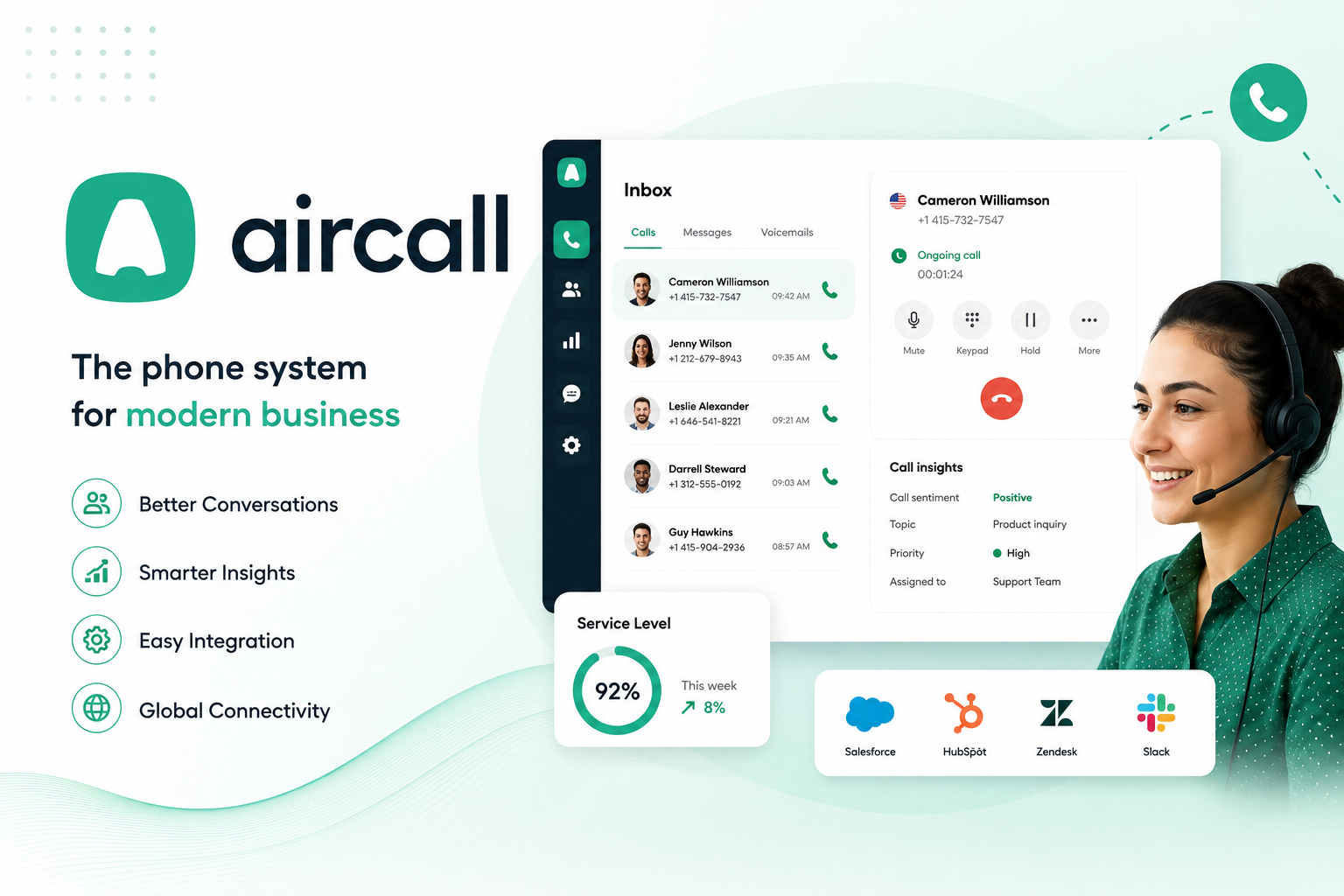
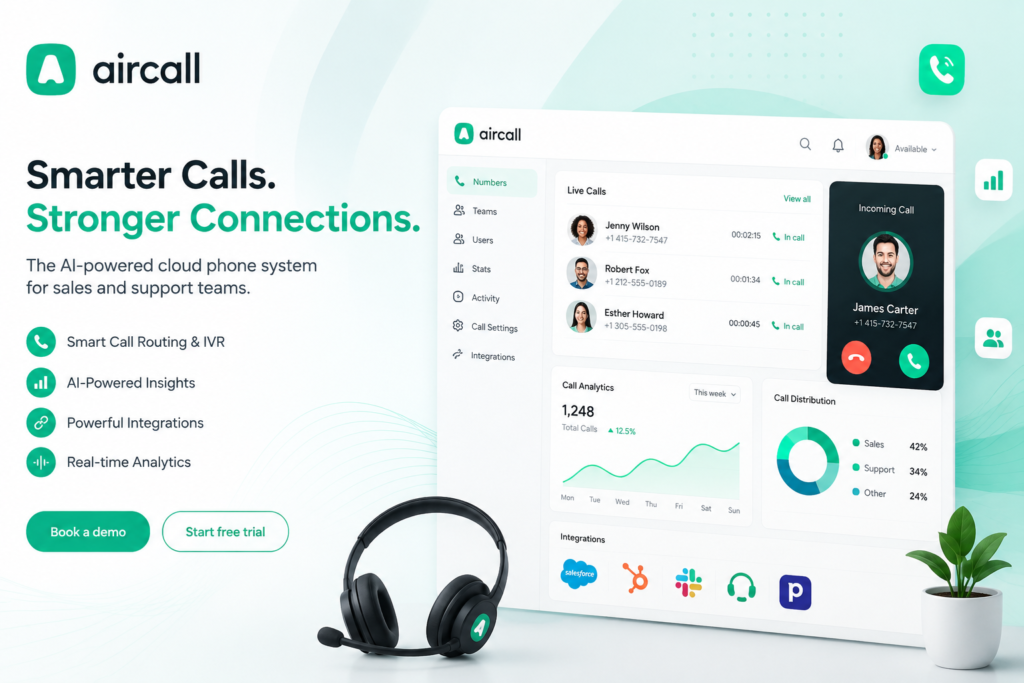
Aircall is an AI-powered customer communications platform built primarily for sales, customer support, and other customer-facing teams.
Unlike a traditional office phone system, Aircall operates in the cloud. This means businesses can make and receive calls from computers and mobile devices without relying on traditional phone hardware.
Aircall also connects with popular CRM, help desk, and business applications, allowing teams to keep customer conversations and data connected across their workflow.
For growing businesses, this can make managing calls significantly easier while providing managers with better visibility into team performance.
How Does Aircall Work?
Aircall works as a cloud-based business phone system.
Once a business creates an account, administrators can add users, purchase or connect phone numbers, configure call routing, and integrate Aircall with existing business applications.
Team members can then make and receive calls using Aircall Workspace on their computers or through the Aircall mobile application.
Because everything is cloud-based, employees can communicate with customers from the office, home, or while working remotely.
Key Features of Aircall
1.Cloud-Based Business Phone System
Aircall replaces traditional business phone infrastructure with a modern cloud-based calling platform.
Businesses can manage users, phone numbers, call routing, and communication settings from a centralized dashboard.
This makes Aircall particularly useful for remote and distributed teams.
2. Interactive Voice Response (IVR)
Aircall includes Interactive Voice Response functionality that helps businesses direct callers to the appropriate department or team.
For example:
“Press 1 for Sales”
“Press 2 for Customer Support”
“Press 3 for Billing”
A well-designed IVR system can reduce unnecessary call transfers and help customers reach the right person faster.
3. Call Recording
Businesses can record customer calls for training, quality assurance, and performance analysis.
Sales managers can review conversations to identify successful sales techniques, while support managers can use recordings to improve customer service quality.
Businesses should ensure that their call-recording practices comply with applicable local privacy and consent laws.
4. Smart Call Routing
Aircall provides routing capabilities that help incoming calls reach the appropriate agents.
Its Professional plan includes advanced support features such as smart routing and queue callbacks.
This can be particularly useful for customer service teams handling large volumes of incoming calls.
5. Power Dialer
Sales representatives often spend a significant amount of time manually dialing prospects.
Aircall’s Power Dialer, available with its Professional plan, helps sales teams move through calling lists more efficiently.
Instead of manually entering every number, representatives can work through their prospect lists faster and spend more time actually speaking with potential customers.
6. Call Analytics
Aircall provides analytics that allow managers to understand how their teams are performing.
Depending on the plan, businesses can access information related to call activity, agent performance, and operational trends.
The Professional plan includes advanced analytics and live monitoring.
These insights can help businesses identify problems such as long wait times, missed calls, or overloaded teams.
Aircall AI Features
Artificial intelligence has become an increasingly important part of Aircall’s platform.
Aircall now combines its cloud phone system with AI-powered conversation intelligence and automated voice capabilities.
AI Assist
Aircall AI Assist can analyze customer conversations and provide useful information to teams.
Features include:
Automatic call summaries
Call transcription and transcript search
Customer sentiment insights
Key conversation topics
Automatically detected action items
These capabilities reduce the amount of manual work required after customer conversations.
For example, instead of writing detailed notes after every sales call, representatives can use AI-generated summaries to quickly understand what happened and what needs to happen next.
AI Assist is included with Aircall’s Professional plan.
AI Voice Agent
Aircall also offers AI Voice Agents that can handle certain customer conversations automatically.
Rather than relying only on traditional “press 1, press 2” menus, an AI voice agent can interact with callers conversationally.
Businesses can use voice AI for repetitive or straightforward customer requests while transferring more complicated conversations to human agents.
This can help companies provide assistance outside normal business hours and reduce pressure on customer support teams.
Aircall Integrations
One of Aircall’s biggest strengths is its integration ecosystem.
Aircall supports more than 250 integrations and API access, allowing businesses to connect calling workflows with the tools they already use.
These integrations can include CRM platforms, help desk software, productivity tools, and other business applications.
Connecting Aircall with a CRM can be particularly valuable for sales teams because customer conversations and related information can remain connected to customer records.
Instead of constantly switching between multiple platforms, representatives can access relevant customer context during their workflow.
If you’re exploring other AI-powered business tools, check out our guide to the best free AI tools in 2026.
Aircall Pricing in 2026
Aircall currently offers three primary pricing options.
Essentials – $30 per license/month
The Essentials plan starts at $30 per license per month when billed annually.
It includes features such as:
- 250+ integrations and API access
- Unlimited calls within the US and Canada, subject to Aircall’s terms
- IVR
- Call recording
- Click-to-dial
- Access to AI Voice Agent usage
A minimum of three licenses means the displayed annual-billing configuration starts at $90 per month for three licenses.
Professional – $50 per license/month
The Professional plan starts at $50 per license per month when billed annually.
It includes everything available in Essentials plus additional capabilities such as:
- AI Assist
- Salesforce CTI integration
- Advanced analytics
- Live monitoring
- Smart routing
- Queue callback
- Power Dialer
- Voicemail Drop
- Mandatory call tagging
For businesses with active sales or customer support teams, Professional is likely to be the more relevant option.
Custom Plan
Larger organizations can choose a customized Aircall package.
Custom plans can include capabilities such as:
- Unlimited calls worldwide, subject to applicable conditions
- Custom onboarding
- API developer support
- Service-level agreement (SLA)
- Single sign-on
Aircall lists a 25-license minimum for its Custom package.
Pricing is customized based on the organization’s requirements.
Aircall Pros and Cons
Pros
Easy cloud-based setup
Businesses don’t need to maintain a traditional on-premise phone infrastructure.
Strong CRM and business integrations
With 250+ integrations and API access, Aircall can fit into many existing sales and customer support technology stacks.
Useful for sales teams
Features such as Power Dialer, Voicemail Drop, call recording, and CRM integrations can improve outbound sales workflows.
Advanced analytics
Managers can monitor team activity and use call data to identify performance issues.
AI-powered conversation intelligence
AI-generated summaries, sentiment insights, transcripts, and action items can reduce manual administrative work.
AI Voice Agents
Businesses can automate certain repetitive customer conversations and provide greater availability.
Cons
Three-license starting point
The standard plans are structured around a minimum of three licenses, which may be less attractive for solo users or very small teams.
Advanced features require higher plans
Some valuable features, including advanced analytics, Power Dialer, and advanced routing capabilities, are available with the Professional plan rather than Essentials.
AI usage can increase overall costs
Businesses using AI Voice Agents extensively should account for usage-based AI charges in addition to their regular subscription.
May be more than very small businesses need
Companies that only need a basic business phone number without CRM integrations, analytics, or advanced sales features may find simpler alternatives sufficient.
Who Should Use Aircall?
Aircall is particularly suitable for businesses where customer conversations directly influence sales, support, or revenue.
Sales Teams
Sales teams can benefit from Power Dialer, call recording, CRM integrations, AI summaries, and performance analytics.
These features can help representatives spend less time performing administrative tasks and more time communicating with prospects.
Customer Support Teams
Support teams can use IVR, call routing, queue callbacks, analytics, call recording, and AI-powered conversation tools to manage customer calls efficiently.
Remote Teams
Because Aircall is cloud-based, employees don’t have to be physically located in the same office.
This makes it suitable for remote and internationally distributed teams.
Growing Businesses
Businesses moving away from traditional phone systems may benefit from Aircall’s scalability and integrations.
New users and numbers can be added as teams expand.
Is Aircall Worth It in 2026?
Aircall is a strong option for businesses looking for more than a basic VoIP phone system.
Its combination of cloud calling, integrations, analytics, sales tools, conversation intelligence, and AI Voice Agents makes it particularly useful for modern sales and customer service teams.
However, smaller businesses should carefully evaluate the minimum license requirements and whether they actually need the more advanced features available in higher-tier plans.
For organizations that rely heavily on customer conversations and want their phone system deeply connected with CRM and support workflows, Aircall can be a compelling choice.
Final Verdict
Aircall has evolved from a cloud-based business phone system into a broader AI-powered customer communications platform.
Its strongest advantages are its extensive integrations, sales and support features, analytics, and growing AI capabilities.
The platform is particularly well suited to growing sales teams, customer support departments, remote teams, and businesses that want to connect customer conversations directly with their existing technology stack.
If your organization makes or receives a significant number of customer calls, Aircall is certainly worth considering in 2026.
Frequently Asked Questions
Aircall is used by businesses to make, receive, manage, route, record, and analyze customer calls. It is primarily designed for sales, support, and other customer-facing teams.
Yes. Aircall provides a cloud-based business communication and calling system that uses internet-based technology rather than relying solely on traditional office phone infrastructure.
Aircall’s Essentials plan currently starts at $30 per license per month when billed annually, while Professional starts at $50 per license per month. Custom pricing is available for larger organizations.
Yes. Aircall provides AI-powered features including call summaries, transcription, sentiment insights, action items, conversation intelligence, and AI Voice Agents.
Yes. Features such as Power Dialer, Voicemail Drop, CRM integrations, call recording, analytics, and AI-generated conversation insights make Aircall particularly useful for outbound and inbound sales teams.